STFU Meaning: What Does STFU Mean in Text and Social Media?
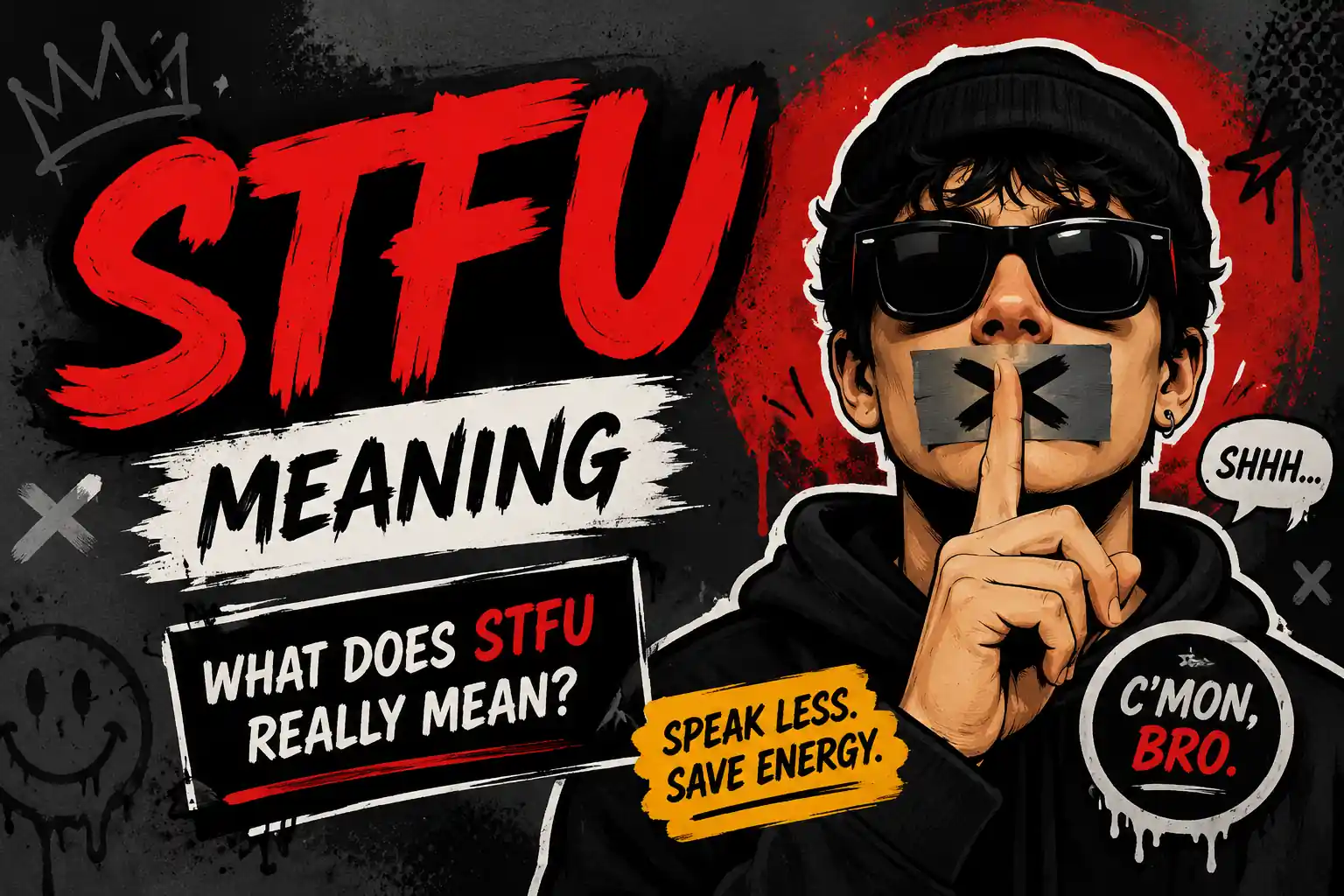
STFU is an internet acronym for “shut the fuck up.” It’s used either as a blunt, angry demand for someone to stop talking, or — especially in lowercase (“stfu”) among friends — as a casual exclamation of shock, disbelief, or excitement, much like saying “no way!” or “shut up!” The correct stfu meaning depends entirely on tone, capitalization, and context.
Key Takeaways
Full form: “Shut the f*** up” — a blunt command to stop talking.
Two meanings: Genuine anger/dismissal, OR (more commonly online) shock and disbelief.
Case matters: ALL CAPS tends to read as angry; lowercase “stfu” usually reads as playful or surprised.
First recorded use: Urban Dictionary, 2003 — rooted in early-2000s chat rooms and gaming culture.
Never appropriate in professional, academic, or formal communication.
Common variant: STFUIDWYC (“…I don’t want your conversation”), popularized by Frank Ocean’s “Nights.”
What Does STFU Mean?
STFU is one of the most-searched internet acronyms because it shows up constantly in texts, comment sections, and group chats — and it can look genuinely hostile if you don’t already know the context. At its core, STFU literally means “shut the f*** up.” It’s a slang way of telling someone to stop talking.
But here’s the part most quick definitions miss: on modern social platforms, STFU is rarely used with its full literal force. It has split into two distinct, commonly understood meanings, and figuring out which one applies depends almost entirely on tone, punctuation, and who’s saying it.
STFU Full Form
The full form of STFU is simple and consistent across every dictionary, forum, and slang glossary:
| Letter | Stands For |
|---|---|
| S | Shut |
| T | The |
| F | Fuck |
| U | Up |
There is no alternate “clean” or official meaning. Unlike acronyms such as ASAP or FYI, STFU was built from the start as a censored shorthand for profanity, not as a formal abbreviation — which is why you won’t find it in style guides or professional writing standards.
The Two Real Meanings of STFU
Most dictionary-style definitions stop at the literal translation. In actual usage, STFU carries two distinct emotional registers:
1. Anger or Dismissal (the literal meaning)
This is STFU used at full force — a rude, confrontational way to tell someone to stop talking, usually because you’re annoyed, insulted, or trying to end an argument.
“I’m trying to focus on this deadline. STFU.”
Direct, irritated command — read as genuinely hostile.
“STFU, nobody asked for your opinion.”
Dismissive put-down in a heated exchange.
2. Shock, Disbelief, or Playful Excitement
This is the more common use in everyday texting and comment sections. Here, STFU doesn’t mean “stop talking” at all — it functions more like “no way,” “are you serious?”, or “get out of here!” It’s a reaction to something surprising, funny, or hard to believe.
“You just won the lottery? STFU!”
Excited disbelief — the opposite of wanting them to stop talking.
“stfu that’s actually so funny 😂”
Casual, affectionate reaction among friends.
Quick rule of thumb: If STFU is followed by more conversation, an emoji, or excitement (“no way,” “fr?”, “tell me more”) — it’s the disbelief meaning. If it’s a short, sharp standalone reply during a disagreement, it’s the angry meaning.
Origin & History of STFU
STFU belongs to the first wave of internet shorthand that emerged from IRC chat rooms, early instant messengers, and text-message character limits in the late 1990s and early 2000s. Typing speed mattered in fast-moving chats and competitive online gaming, so blunt, multi-word phrases got compressed into acronyms — STFU joined other early expletive shorthand like FU and GTFO.
The earliest widely cited public definition dates to 2003 on Urban Dictionary, where it was logged simply as shorthand for the phrase, used “for efficiency reasons” during fast typing. From there, it spread from gaming and chat-room culture into mainstream texting, forums, and eventually every major social platform.
By the 2010s, the second, gentler “disbelief” meaning had taken hold — likely influenced by the broader trend of “shut up!” being used as an exclamation of surprise in spoken English since the 1980s and 90s, well before it became an internet acronym.
STFU vs. stfu: Does Capitalization Matter?
Yes — and this is one of the most overlooked details about how the term actually functions in real conversations.
| Form | Typical Tone | Example |
|---|---|---|
| STFU! (all caps) | Sharp, angry, confrontational | “STFU. I’m not arguing about this again.” |
| stfu (lowercase) | Dismissive, casual, often playful | “stfu you’re lying lol” |
This isn’t a hard rule — tone in text is never 100% reliable — but it’s a pattern consistent enough across chats, comment sections, and group texts that it’s worth knowing before you reply.
Is STFU Offensive or Abusive?
This is the question most people are really asking when they search “STFU meaning” — and the honest answer is: it depends on context.
Why it can be offensive
- It contains explicit profanity (“f*** up”).
- Used toward strangers, coworkers, or in professional settings, it reads as rude and unprofessional regardless of intent.
- Used repeatedly or aggressively toward a partner, friend, or family member, it can function as a verbal put-down or silencing tactic.
Why it often isn’t
- Between close friends, it’s frequently used as a joke or reaction to surprising news, with zero hostility intended.
- It’s standard, low-stakes vocabulary in gaming chats, meme culture, and Gen Z/younger-millennial texting norms.
Important nuance: Whether STFU is abusive depends less on the word itself and more on pattern, power dynamic, and consent. A single joking “stfu 😂” between friends is not the same as repeated angry “STFU” messages used to shut someone down during a disagreement or to control a conversation. If you’re on the receiving end of the latter, that’s worth taking seriously regardless of the slang involved.
Bottom line: Treat STFU the same way you’d treat any swear word — fine in casual, consenting contexts; inappropriate in formal, professional, or unfamiliar ones; and a potential red flag if it’s part of a repeated pattern of hostility.
How to Use STFU (With Examples)
If you’ve decided STFU fits the context, here’s how it plays out across common situations:
To express genuine irritation
“Can you STFU for one second so I can think?”
“STFU, you weren’t even there.”
To react to surprising or funny news
“Wait, you got the job?? STFU, congrats!!”
“stfu no way you actually did that”
Playfully, among close friends
“stfu you’re so dramatic 😭”
“omg stfu, stop it”
When to avoid it entirely: Professional emails, school/work messaging tools, conversations with people in authority over you, customer service interactions, and any first-time or unfamiliar relationship.
STFU on TikTok, Snapchat, Discord & Other Platforms
The core meaning of STFU doesn’t change across apps, but the likely intent shifts slightly depending on where you see it:
| Platform | Most Common Use |
|---|---|
| TikTok comments | Reaction to shocking, funny, or impressive videos — almost always the “disbelief” meaning |
| Snapchat / texting | Casual, between-friends use; tone usually softened by emojis or following context |
| Instagram comments | Often sarcastic or exaggerated for comedic effect |
| Discord / gaming chats | Can be either meaning — frequent, fast-paced, and often genuinely competitive or heated |
| X (Twitter) | Frequently used in quote-replies expressing disbelief at news or screenshots |
| WhatsApp (private chats) | Tends to carry more emotional weight since it’s 1:1 — context and history matter more |
STFU Variants You’ll Also See Online
STFU has spawned several extended variants, each adding a more specific layer of meaning:
| Variant | Full Meaning | Notes |
|---|---|---|
| STFUIDWYC | Shut the f*** up, I don’t want your conversation | Popularized by Frank Ocean’s song “Nights”; used to dismiss someone’s input entirely, not just ask for quiet |
| STFFU | Shut the f*** up (emphasized double-F variant) | Informal intensifier spelling, mostly seen in chat slang and meme captions |
| GTFO | Get the f*** out | Related but distinct — tells someone to leave, not just be quiet |
If you’ve seen “STFUIDWYC” specifically, it almost always traces back to or references the Frank Ocean lyric — it’s not a standalone coinage with separate origins.
STFU in Pop Culture
STFU has moved well beyond chat slang into music and media titles, which has helped cement it in mainstream vocabulary rather than keeping it confined to internet-only use:
- Musicians including Rina Sawayama and Iggy Azalea have released songs titled “STFU,” both leaning into the term’s blunt, confrontational energy.
- Frank Ocean’s lyric in “Nights” (“shut the fuck up, I don’t want your conversation”) is the direct source of the STFUIDWYC variant discussed above.
- The phrase regularly appears in meme captions, reaction GIFs, and stitched TikTok/Reels comment threads, almost always in the disbelief sense rather than the angry one.
Similar & Related Slang
| Term | Meaning | Tone |
|---|---|---|
| STFU | Shut the f*** up | Angry or disbelieving |
| GTFO | Get the f*** out | Dismissive / disbelieving |
| SHUT UP | Be quiet (non-vulgar) | Same dual-meaning pattern as STFU, minus profanity |
| BRUH | Expression of disbelief | Casual, non-aggressive |
| FR (For Real) | Confirming sincerity / agreement | Neutral |
| SYBAU | Shut your b**** a** up | More aggressive than STFU |
How to Respond to STFU
Your reply should match the tone you received — and if you’re not sure which meaning was intended, it’s reasonable to ask.
If it was playful
- “Lol I know right”
- “Stop, it’s true though 😭”
If it felt genuinely hostile
- “I’m going to step away from this conversation for now.”
- “Let’s keep this respectful — can we revisit this later?”
If STFU (or similar language) becomes a repeated pattern aimed at silencing or controlling you in a relationship, that pattern matters more than any single message — and is worth discussing with someone you trust or, if needed, a counselor.
FAQs
What does STFU actually mean?
STFU stands for “shut the f*** up.” Literally, it’s a command to stop talking. In real usage, it has two meanings: an angry, dismissive demand for quiet, or — more commonly in casual texting — a playful exclamation of shock or disbelief, similar to “no way!”
Is STFU an abusive word?
It can be, depending on context. Used aggressively, repeatedly, or to silence someone in an argument, it functions as a verbal put-down. Used jokingly between friends reacting to surprising news, it isn’t inherently abusive. The relationship, frequency, and intent behind it matter more than the acronym itself.
Is it offensive to use STFU?
It contains profanity, so it’s inappropriate in formal, professional, or unfamiliar settings. Among close friends in casual contexts, it’s widely treated as harmless slang, especially when used to express disbelief rather than anger.
What does STFU mean in a text message?
In texting, STFU usually still means “shut the f*** up,” but the emotional tone depends on capitalization and what follows it. All-caps with an exclamation point reads as angry; lowercase followed by excitement or an emoji usually means disbelief.
Does STFU always mean someone is angry?
No. While it began as an angry command, it’s now just as commonly used to express shock, disbelief, or amused surprise, with no real anger or desire for the other person to actually stop talking.
What is STFUIDWYC?
STFUIDWYC stands for “shut the f*** up, I don’t want your conversation.” It’s an extended variant of STFU popularized by Frank Ocean’s song “Nights,” used to dismiss someone’s input more pointedly than a plain STFU.
Should I say STFU to my boss or in a professional email?
No. STFU should never be used in professional, academic, or formal communication. Its profanity and aggressive tone can be read as unprofessional or even disrespectful, regardless of how casually you meant it.
Is STFU the same in every English-speaking country?
The meaning and full form are consistent in the US, UK, Canada, Australia, and other English-speaking regions, since it’s rooted in internet and texting culture rather than regional dialect. Tolerance for casual profanity in chat varies slightly by culture and age group, but the acronym itself translates the same way everywhere.
One Comment