SYBAU Meaning: What Does SYBAU Mean in Text & on TikTok?
The complete breakdown of the viral TikTok slang – where it came from, how every platform uses it, what “Don’t SYBAU” means, and everything else you need to know.
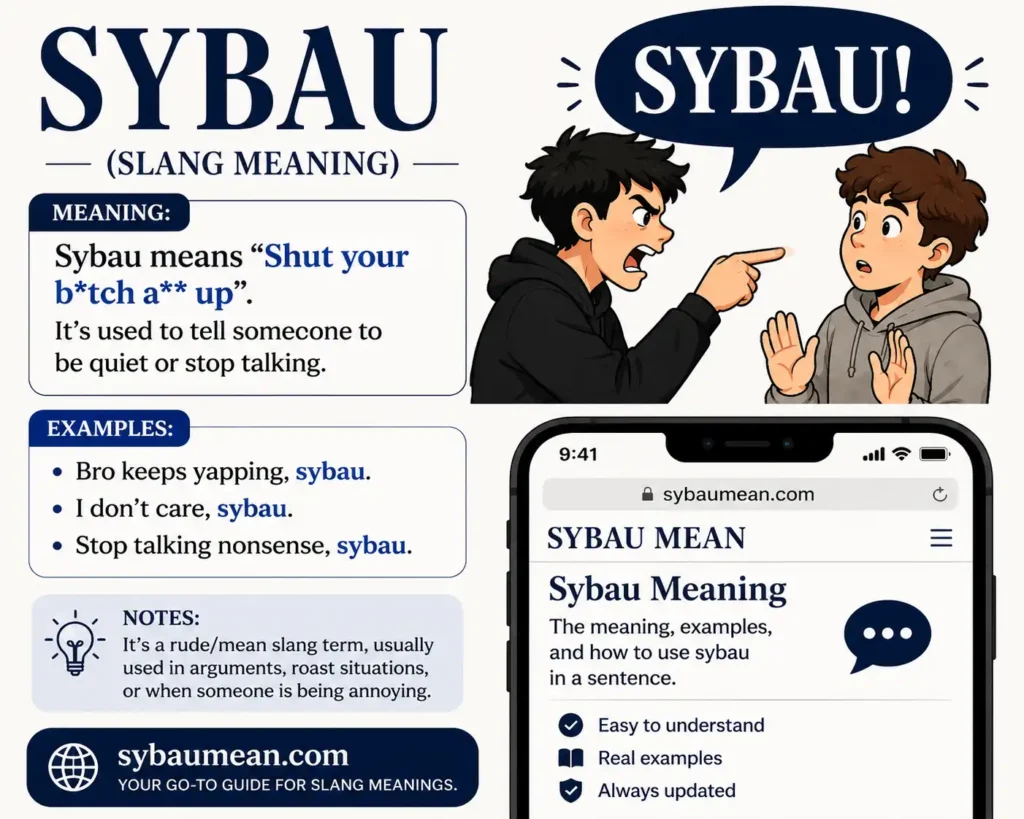
SYBAU = “Shut Your Bitch Ass Up“
SYBAU is an internet slang acronym that stands for “Shut Your Bitch Ass Up.” It is used in text messages, TikTok comments, Discord servers, and across social media to tell someone to stop talking – either aggressively as a direct insult, or playfully between close friends depending entirely on tone and context. The phrase originated in Black internet communities and exploded into mainstream online culture through TikTok in 2024–2026, where it became one of the most recognized dismissive reactions in comment sections. It is listed in Merriam-Webster’s slang dictionary and has been covered by The Guardian and multiple media outlets.
What Does SYBAU Stand For?
If you are searching for what does SYBAU stand for or SYBAU stand for, each letter represents one word in the full phrase:
Breaking Down the Acronym
Each of the five letters in SYBAU corresponds to one word in the full phrase “Shut Your Bitch Ass Up”:
S
Shut
Y
Your
B
Bitch
A
Ass
U
Up
SYBAU Pronunciation
How do you pronounce SYBAU?
SYBAU pronunciation is commonly said as the individual letters: “S-Y-B-A-U.” Because it is an acronym, spelling it out letter by letter is the clearest way to say it in conversation.
⚠️ Strong Language
SYBAU contains strong profanity and is not appropriate in schools, workplaces, professional settings, or around children. It is considered aggressive internet slang even when used jokingly.
The phrase is a classic internet acronym – taking a vulgar expression that would be flagged or filtered on some platforms and compressing it into five letters that fly under content moderation radar. This is the same reason STFU, ENM, WTF, and similar acronyms became popular: they carry the emotional weight of the full phrase while appearing less offensive at a glance.
Origin & History of SYBAU
SYBAU has a longer history than most people realize. While it feels like a TikTok-era invention, the phrase “shut your bitch ass up” has roots in African American Vernacular English (AAVE) and appeared in online spaces well before it became a mainstream acronym.
Mid-2010s
The phrase “shut your bitch ass up” circulates in Black internet spaces, Twitter (now X), and forums. The acronym SYBAU begins appearing in comment sections and gaming chat.
2018–2022
SYBAU gains traction in Discord servers, particularly in gaming communities and stan Twitter. It becomes part of the toolkit of internet clapbacks and heated online arguments.
2024
SYBAU explodes on TikTok. Creators use it in reaction videos, response memes, and comment sections. It begins appearing in mainstream media coverage of Gen Z slang. Search volume surges.
2025
Merriam-Webster officially documents SYBAU in their slang dictionary. The Guardian covers it in their teen slang guide. The phrase cements its place in documented internet language history.
2026
SYBAU remains widely recognized and used across TikTok, X, Discord, and text messaging. It has become a stable part of Gen Z internet vocabulary rather than a fading trend.
🗂️ Cultural origin note
SYBAU originated in Black internet communities before spreading broadly online. Like many widely-used slang terms – “no cap,” “bussin,” “slay,” “fr fr” – it traveled from Black cultural spaces into mainstream internet usage through TikTok’s algorithm and general social media spread. Recognizing this origin matters for understanding where internet language actually comes from.
How to Use SYBAU
If you are looking for the SYBAU slang meaning, remember that the exact tone depends on the situation, relationship, and platform.
The meaning and impact of SYBAU shifts dramatically based on context, relationship, and tone. The same five letters can function as a genuine insult or a term of endearment depending on who is saying it and to whom.
Aggressive / confrontational use
This is the original and most intense use of SYBAU. When used aggressively, it functions as a direct command to stop talking – with significant hostility attached. It is typically directed at someone whose opinion is considered unwanted, wrong, or overbearing.
“Nobody asked for your opinion. SYBAU.“
“You’ve been talking for an hour straight. Bro, SYBAU.”
“That take is factually wrong on every level. SYBAU.“
“I can’t believe you’re still arguing about this. SYBAU already.“
Playful use — between close friends
When used between friends with the right tone, SYBAU shifts into affectionate teasing. It functions similarly to “oh stop it” or the playful use of “shut up” – the person does not literally want the other to be silent; it’s a reaction to something funny, embarrassing, or dramatic.
“You said my cooking was bad? SYBAU lmao 😭”
“Stop being so dramatic. SYBAU bestie 💀”
“You really just sent that meme? SYBAU I’m crying 😂”
“Omg you actually said that to him? SYBAU no way”
As a reaction to online content
On TikTok, X (formerly Twitter), and Reddit, SYBAU is commonly used as a one-word response to a post or opinion the commenter considers absurd, wrong, or insufferable. It functions like a mic drop – ending the conversation rather than continuing it.
[In response to a controversial opinion post] “SYBAU 💀”
“Every time this person posts, I just have to say SYBAU and scroll.”
“The audacity. The nerve. SYBAU.“
💡Reading the room
The key to understanding whether SYBAU is playful or hostile is context – your relationship with the person, the platform, the surrounding conversation, and the presence of emoji like 😭💀😂 (which typically signal the playful register). A standalone “SYBAU.” with a period and no emoji almost always reads as aggressive.
What Does Don’t SYBAU Mean?
“Don’t SYBAU” – also written as “dont SYBAU” without the apostrophe — completely reverses the meaning of the original phrase. Where SYBAU tells someone to stop talking, “Don’t SYBAU” encourages them to keep going.
It means: “Please keep talking. I want to hear what you have to say. Don’t silence yourself.”
✅Reverse usage — encouragement
“Don’t SYBAU” = “Please keep talking” or “Your voice matters — don’t stop.” It became popular in TikTok comment sections where viewers would use it to support creators sharing personal stories, unpopular opinions, or vulnerable content.
“You can vent to me anytime. Don’t SYBAU – I genuinely want to hear it.”
“Your opinions are valid and interesting. Dont SYBAU.”
“Keep posting. Don’t SYBAU, this content is needed.”
“People might disagree but I think you’re right. Don’t SYBAU.”
The “Don’t SYBAU” construction shows how internet slang evolves – the same five-letter acronym gets inverted to create a completely opposite meaning, expanding the usefulness of the term beyond its original hostile application.
What Does SYBAU Mean on TikTok and Other Platforms?
The SYBAU meaning on TikTok is usually the same as the core slang meaning, but the context can vary by platform. The sections below show how the term appears online.
SYBAU Across Different Platforms
While the core meaning of SYBAU stays consistent, how it is used, how common it is, and what it signals varies depending on the platform. Here is a breakdown of SYBAU usage across major online spaces:
TikTok
The primary home of SYBAU’s viral explosion. Used in comment sections reacting to controversial videos, as text overlay in reaction/response videos, and in meme formats. Peaked in 2024 but remains in active circulation in 2026.
X / Twitter
Used as a quote-tweet response to bad takes, clout-chasing posts, or opinions deemed insufferable. Functions as a one-word dismissal that ends discussion rather than engaging with it.
Discord
Common in gaming servers and friend group chats. Used both aggressively during arguments and playfully in casual conversation. Server bots sometimes filter it due to the embedded profanity.
Text messages
Used between friends as a quick, high-intensity reaction. The playful register is more common here since text conversations are typically between people who know each other well.
Roblox
SYBAU entered Roblox communities through TikTok culture. Roblox’s automated filtering detects it in some contexts. Given the platform’s young user base, it is flagged as inappropriate by the platform’s guidelines.
Appears in Reels comments and Story replies. Less prominent than on TikTok but used in the same dismissive-reaction context, often in response to content perceived as out-of-touch or irritating.
SYBAU Meaning “Nice” — The Playful Version
Many people search specifically for a “nice” or “soft” version of SYBAU. This refers to the affectionate, playful use of the phrase that exists in close friendships and familiar online relationships.
In a nice context, SYBAU functions the same way as saying “oh stop it,” “shut up (you’re embarrassing me),” or “stop being ridiculous” to a close friend — the words are harsh but the intent is warm. The literal meaning of “Shut Your Bitch Ass Up” does not change, but the emotional register does entirely.
Signs that SYBAU is being used in a nice/playful way:
Accompanied by laughing emoji: 😂 💀 😭 — these signal levity and affection
Said in response to something funny the other person did or said
Followed by “bestie,” “bro,” “lmao,” or other softening terms
Said in a group chat context where the relationship dynamic is clearly playful
🧭If you’re unsure, read the room
The “nice” version of SYBAU only works when both parties clearly understand the relationship context. Using SYBAU in the playful register with someone who might take it literally — or in a semi-professional online space — can cause unintended offense. When in doubt, err toward a milder expression.
SYBAU Slang Meaning vs. STFU — What’s the Difference?
The SYBAU meaning slang users see online can overlap with STFU, but the two acronyms are not identical. Here is how they differ.
SYBAU and STFU are the two dominant “stop talking” acronyms in internet culture, but they differ in intensity, era, and cultural associations. Understanding the difference matters for understanding how online language evolves across generations.
| Term | Full form | Intensity | Era | Cultural origin |
|---|---|---|---|---|
| STFU | Shut The F*** Up | High | Early 2000s — widely known, now mainstream | General internet / AOL era |
| SYBAU | Shut Your Bitch Ass Up | Very high | 2015 origin, TikTok mainstream 2024–2026 | Black internet communities / AAVE |
Key distinctions:
Intensity: SYBAU is generally considered more intense than STFU because the full phrase is more specific and visceral. STFU has been used so broadly for so long that some of its shock value has diminished. SYBAU still reads as sharper.
Era: STFU belongs to early internet culture — forums, AIM, early social media. SYBAU belongs to the short-form video era and carries the energy of TikTok comment culture.
Flexibility: Both can be used playfully or aggressively, but SYBAU’s playful use tends to be more associated with close Gen Z friendships and AAVE-influenced online speech.
Evolution of “stop talking” slang across internet eras
2000s
STFU
Forum / AIM era
2010s
I can’t
Tumblr / early Twitter
2018–22
ratio
Twitter reply culture
2024–26
SYBAU
TikTok comment era
Why Did SYBAU Spread So Fast?
SYBAU’s rapid rise from niche acronym to mainstream internet vocabulary is not accidental. Several factors converged to make it uniquely shareable and durable in online culture.
It bypasses content filters
Platforms like TikTok, YouTube, and Instagram use automated systems to detect and reduce the visibility of content containing profanity. SYBAU carries the full emotional punch of “Shut Your Bitch Ass Up” while appearing as a neutral five-letter string to most content moderation algorithms. This gave it a practical advantage over spelling out the phrase.
It is rhythmically satisfying
The full phrase “Shut Your Bitch Ass Up” has a particular rhythm and specificity that made it memorable long before it became an acronym. “Bitch ass” as a compound modifier is a recognizable construction in AAVE that carries specific layered meaning — it implies the target is both weak and irritating. The full phrase packs more contempt into five words than a generic “shut up” achieves.
TikTok’s comment culture amplified it
TikTok’s comment sections reward brevity and reaction. A video with a controversial opinion or a widely-disliked take will attract thousands of one-word or one-phrase dismissals. SYBAU is perfectly suited to this format — five letters, no explanation needed, immediately understood by anyone in the know. It signals group membership (I know this term, I am of the internet) while delivering a clear message.
It has a meaningful inverse
The existence of “Don’t SYBAU” as a complete reversal gave the acronym double utility — it could express both dismissal and encouragement. This flexibility increased the contexts in which the term appeared and helped it spread beyond purely hostile use.
SYBAU Variations and Related Spellings
Like most internet slang, SYBAU appears in multiple forms depending on platform, autocorrect, and user preference:
SYBAU, sybau, syba, dont SYBAU, don’t SYBAU, SYBAU lmao, sybau 💀, sybau significado, sybau meaning nice, what is sybau
The lowercase “sybau” is equally common online — internet acronyms often lose their capitalization in casual use, similar to how “lol,” “omg,” and “ngl” are now almost always written in lowercase despite being initialisms.
“Sybau significado” (Spanish for “SYBAU meaning”) reflects the international spread of TikTok slang. The phrase is used and recognized in Spanish-speaking online communities in the same contexts as in English, though the cultural nuance of the original AAVE-rooted phrase may be lost in translation.
Quick Reference
| Full meaning | Shut Your Bitch Ass Up |
| Type | Internet slang acronym (initialism) |
| Offensive? | Yes — strong, vulgar language containing profanity |
| Playful use? | Yes — between close friends, with emoji context |
| Cultural origin | Black internet communities / AAVE; viral through TikTok |
| First documented | Mid-2010s online communities |
| Mainstream peak | TikTok era 2024–2026 |
| In the dictionary? | Yes — Merriam-Webster slang dictionary |
| “Don’t SYBAU” means | Encouragement — please keep talking, your voice matters |
| Similar to | STFU (older, less intense), “ratio” (different mechanism) |
| Used on TikTok? | Yes — comments, reaction videos, meme formats, overlays |
| Appropriate for? | Adults in casual online/text contexts only. Not for schools, workplaces, formal settings, or around children. |
Frequently Asked Questions
Conclusion
Understanding the SYBAU meaning is mainly about knowing both the literal phrase and the context in which people use it. SYBAU stands for “Shut Your Bitch Ass Up.” It is vulgar internet slang used to dismiss someone – either aggressively or playfully between friends. It originated in Black internet communities, went mainstream on TikTok in 2024, and is now documented in Merriam-Webster’s slang dictionary. “Don’t SYBAU” reverses the meaning entirely, encouraging someone to keep talking.