
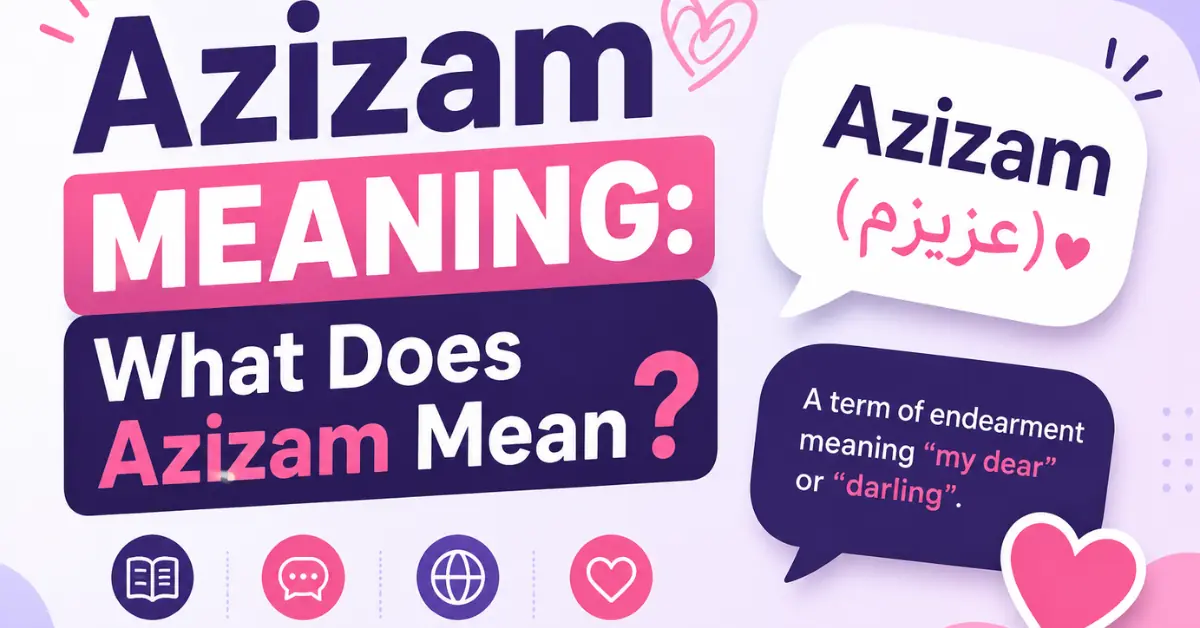
Azizam Meaning: What Does Azizam Mean? Ed Sheeran Explained
Azizam(عزیزم) is a Persian (Farsi) word that means “my dear” or “my beloved.” It’s one of the most common terms of endearment in the Persian language — used warmly between parents and children, close friends, and romantic partners. Pronounced ah-ZEE-zam, it’s gentle, affectionate, and far more flexible in use than most English endearments.
Quick Summary
Azizam Meaning: “My dear” or “my beloved” — from aziz (dear) + -am (my)
Language: Persian / Farsi (عزیزم)
Pronunciation: ah-ZEE-zam (stress on the second syllable)
Gender: Gender-neutral — used for men, women, and anyone
Usage: Family, friends, romantic partners, and even strangers in Persian culture
Not Arabic: The root aziz exists in Arabic, but “azizam” is a specifically Persian construction
Not biblical: Azizam itself isn’t in scripture, but its Semitic root appears in both Arabic and Hebrew traditions
Pop culture: Ed Sheeran’s 2025 lead single from his eighth album, co-written with Iranian-Swedish producer ILYA Salmanzadeh
What Does Azizam Mean?
The straightforward translation is “my dear” — but if you’ve ever had a Persian friend or colleague, you’ll know that azizam carries considerably more warmth than those two words suggest in English. It’s closer to what “sweetheart” might feel like on a good day, or the way some families say “love” instead of a name when they’re talking to someone they adore.
Persian is a language with a deep culture of verbal affection. Unlike in many Western cultures, where terms like “darling” or “honey” are reserved for romantic relationships or very close family, Persians use azizam in a surprisingly wide range of contexts. A grandmother says it to her grandchild. A close friend says it to another. A mother says it when she’s gently reprimanding her son. It has none of the awkwardness that the English equivalent might carry in the same situations.
عزیزم
azizam
My dear / My beloved / My precious
Pronounced: ah-ZEE-zam
How to Pronounce Azizam
Azizam has three syllables and the stress sits firmly on the second one:
- a — short ‘a’ sound, like the ‘a’ in “father”
- ZEE — this is the stressed syllable, long and clear
- zam — soft ending, rhymes with “calm”
Full phonetic guide: ah-ZEE-zam. Think of it as two halves — “ah-ZEE” (like saying “a-Z” out loud) followed by “zam” (like the start of “zombie” but softer). The whole thing flows together quickly in natural Persian speech.
One common mispronunciation from English speakers is putting the stress on the first syllable (“AH-zee-zam”) or the last (“ah-zee-ZAM”). Neither sounds natural. Keep the emphasis in the middle. Read our complete guide to SYBAU meaning.
The Grammar: Aziz + -am
Azizam is a two-part word, and once you understand the structure, you’ll immediately recognize it in dozens of other Persian expressions:
aziz عزیز + -am ـم = azizam عزیزم
Aziz means “dear” or “precious.” The suffix -am is a possessive pronoun meaning “my.” So the full meaning is “my dear” — literally “dear-my” in Persian word order.
The longer, more formal version is “aziz-é man” — where “man” means “me” in Persian and “é” is called an ezafé, a linking sound that connects two words. In everyday speech, this gets compressed to just “azizam.” The same pattern creates joonam (my soul), eshgham (my love), and many other Persian endearments.
The suffix -am makes all the difference between formal and affectionate. “Aziz” alone is polite and a bit distant — you might address a respected elder or an acquaintance as aziz. Add -am and it immediately becomes intimate: now you’re saying “my dear,” and the relationship is implied by the word itself.
Where Does the Word Come From? Azizam Meaning
The root word aziz (عزیز) is ancient, and its history traces back through several languages and cultures before arriving in Persian.
The root is Semitic — shared between Arabic and Persian through centuries of cultural and linguistic exchange. In Arabic, aziz means “mighty,” “dear,” or “precious,” and it carries enough weight to appear as one of the 99 names of God in Islam: Al-Aziz, meaning “The Mighty” or “The Almighty.” That’s the same root as “Abdul Aziz” — the common name meaning “servant of the Almighty.”
In Persian, the word migrated from Arabic roots during the medieval Islamic period and took on a softer, more interpersonal meaning over time. The “mighty/powerful” sense faded, and “precious” or “dear” became dominant. This is why aziz and azizam in everyday Persian feel entirely warm and personal, with no trace of the grander theological associations the root carries in Arabic.
Classical Persian poets — including Hafez and Rumi — used aziz and related forms in their verses. The word has centuries of literary weight behind its casual modern use.
How Persians Actually Use Azizam
This is where most guides on azizam fall short. They give you the translation and leave it there. But understanding how Persians actually use the word in real life is what makes the difference between knowing a word and understanding it.
With Family
Azizam is perhaps most naturally at home in family settings. Parents say it to children. Adult children say it back to parents. Grandparents, aunts, uncles — the word travels freely across generations. It can be tender, and it can also be used as a gentle way to get someone’s attention, the way you might say “come on, love” in British English.
عزیزم، بیا شامت رو تموم کن!
Azizam, biyā shāmat ro tamoom kon!
“My dear, come finish your dinner!”
Parent to child
عزیزم، خیلی دوستت دارم!
Azizam, khayli doostet dāram!
“My dear, I love you so much!”
Any close family member
With Romantic Partners
Of course, azizam is also used between romantic partners — and in this context it does carry the weight of genuine intimacy. A husband calling his wife azizam, or a girlfriend calling her partner azizam, isn’t performing a cultural script. It’s a genuine verbal expression of closeness. This is also the context Ed Sheeran drew on for his song, using it to address his wife.
عاشقتم، عزیزم!
Āsheghetam, azizam!
“I’m in love with you, my dear!”
Romantic partner
With Close Friends
This is where azizam diverges sharply from most Western endearments. Persians use azizam freely between close friends — including between two male friends, which would feel unusual in many English-speaking cultures. It doesn’t carry any connotation other than warmth and closeness. If your Iranian friend calls you azizam, take it as a compliment. It means you’re in the inner circle.
عزیزم، خیلی وقته ندیدمت!
Azizam, khayli vakhté nadeedamet!
“My dear, it’s been so long since I’ve seen you!”
Friend to close friend
With Strangers — The Persian Cultural Context
Here’s the part that genuinely surprises non-Persians: azizam can be used with strangers. A shopkeeper might say it to a customer. An older woman might say it to someone younger on the street. A taxi driver might use it. This is not flirting or overstepping — it’s a cultural norm of warmth and social lubrication. Persian culture tends toward more verbal affection with people in general, and azizam is part of that register.
If you visit Iran and someone calls you azizam, they almost certainly just mean you’re welcome there.
Key point: In Persian culture, azizam signals warmth, not necessarily romantic interest. The English instinct to read endearments as intimate or flirtatious doesn’t always apply. Context, tone, and the setting matter far more than the word itself.
When a Guy Calls You Azizam — What Does It Mean?
If a Persian man has called you azizam and you’re wondering what to make of it, the most honest answer is: it depends on the relationship, not just the word.
Because Persian culture uses azizam so broadly — for family, friends, acquaintances, and romantic partners all at once — a guy calling you azizam is not automatically a declaration of romantic interest. Here’s a more useful way to read it:
| Context | Most Likely Meaning |
|---|---|
| He’s a long-standing friend in conversation | Warm, platonic affection — you’re in his close circle |
| He’s a family member or older figure | Pure familial endearment, no romantic reading needed |
| He’s someone you’re dating or seeing romantically | Genuine intimacy — the word carries full emotional weight in this context |
| He’s a Persian acquaintance in casual conversation | Cultural warmth — this is normal social speech in Persian culture |
| He uses it specifically in a compliment or special moment | Likely has romantic or deeply personal meaning in that instance |
The word itself won’t tell you everything. But the circumstances, the look, the tone, and what came before it — those will.
Is Azizam Appropriate at Work?
Generally, no — not in formal professional settings. This is one of the questions that actually comes up on Quora from non-Persians working with Iranian colleagues, and the short answer matches common sense: calling a coworker azizam in a professional context is similar to calling them “darling” or “sweetheart” in English. Even in Persian-speaking offices, it’s understood as a personal, informal register that doesn’t belong in formal professional relationships.
That said, Persian workplaces can vary widely. In a relaxed, informal environment among long-term colleagues who have become close friends, it can emerge naturally. In a formal corporate or hierarchical setting, it would almost always feel out of place.
Simple rule: If you wouldn’t call that person “sweetheart” in a work email in English, don’t call them azizam in a Persian professional context.
Is Azizam Arabic or Persian?
Azizam is Persian, not Arabic. This is one of the most common confusions about the word, and it’s understandable given how much Arabic vocabulary Persian has absorbed over the centuries.
Here’s the actual breakdown:
- The root word aziz exists in Arabic and means “dear,” “precious,” or “mighty.” Arabic speakers do use aziz in everyday speech.
- But the suffix -am is Persian grammar. In Arabic, the possessive suffix works differently — Arabic uses azizi (masculine) or azizati (feminine) to mean “my dear,” not azizam.
- So “azizam” as a single word is a specifically Persian construction. You’ll rarely hear it from a native Arabic speaker who isn’t also familiar with Persian.
Short answer for search: The root aziz is shared between Arabic and Persian — both cultures have it. But “azizam” specifically is Persian, because the -am suffix is Persian, not Arabic.
Is Azizam in the Bible?
Azizam as a Persian phrase does not appear in the Bible. But this question points at something genuinely interesting about the word’s roots.
The root “aziz” is Semitic — it belongs to a family of related sounds and meanings that appears across Arabic, Hebrew, and Aramaic. In the Hebrew Bible, a linguistic relative of aziz appears in the root that means “reputable” or “powerful,” and a figure named Aziz is mentioned in the genealogies of 1 Chronicles. These are related by linguistic descent, not by identical meaning or usage.
In Islam, Al-Aziz — The Almighty or The Mighty — is one of the 99 names of God mentioned in Islamic tradition, and it comes from this same root. This is also why “Abdul Aziz” means “servant of the Almighty” as a name.
So the honest answer is: azizam the Persian endearment is not biblical. But its ancient linguistic ancestors span Hebrew, Arabic, and Aramaic religious traditions. The word as everyday Persian use carries none of that theological weight — it simply means “my dear.”
Azizam vs. Joonam vs. Aziz — What’s the Difference?
These three words come up together so often that it’s worth comparing them properly:
| Word | Literal Meaning | Feel / Register | Best English Equivalent |
|---|---|---|---|
| Azizam (عزیزم) | My dear / My precious | Warm, widely used, versatile | “My dear” / “Sweetheart” |
| Joonam (جونم) | My soul / My life | Slightly more dramatic and poetic | “My darling” / “My love” (but deeper) |
| Aziz (عزیز) | Dear / Precious | Polite, slightly more formal | “Dear” (as in “Dear [Name],”) |
In practice, azizam and joonam are interchangeable in most situations — Persians reach for whichever one comes to mind. Joonam has a slightly more dramatic, poetic edge (you’re literally saying “my soul”). Aziz alone is what you’d use in a more neutral, respectful context where azizam might feel a touch too warm for the relationship.
There’s also a memorable use of joonam that azizam can’t do: said alone as a one-word response to your name being called, “joonam?” means “yes, dear?” — a beautiful, economical little exchange that demonstrates how deeply these words are woven into everyday Persian speech.
Azizam in Other Languages — How It Compares
If you’re not a Persian speaker but you’ve heard azizam and want to understand it through words you already know, here are its closest cultural relatives:
| Language | Word | Meaning | Notes |
|---|---|---|---|
| Arabic | Habibi (m) / Habibti (f) | My love / My dear | Gender-specific, unlike azizam |
| Turkish | Azizim / Canım | My dear / My soul | Azizim follows the same root; Canım is closer to joonam |
| Urdu / Hindi | Jaanu / Meri Jaan | Sweetheart / My life | Commonly used in South Asian romantic speech and Bollywood |
| Hebrew | Ahuvi (m) / Ahuvati (f) | My beloved | More explicitly romantic in usage |
| French | Mon chéri / Mon cher | My dear | Very similar usage range to azizam |
One thing worth noticing in this table: Arabic, Hebrew, Urdu, and many other languages have gender-specific forms for their endearments. Persian doesn’t. Azizam is the same word regardless of who you’re speaking to — one of the ways Persian grammar reflects a less gendered linguistic world.
Ed Sheeran’s “Azizam” — Why He Sang It
🎵 Ed Sheeran — “Azizam” (2025)
Released as the lead single for Ed Sheeran’s eighth studio album in April 2025, “Azizam” marked the start of a new era after his Mathematics pentalogy. The song is a love letter to his wife, Cherry Seaborn — the word azizam used to address her throughout the chorus.
The backstory is genuinely interesting. Ed co-wrote the song with ILYA Salmanzadeh — an Iranian-born Swedish producer who has worked with Ariana Grande, Taylor Swift, and The Weeknd. ILYA grew up with Persian music and culture and suggested exploring that sound for a song. Ed took to it immediately.
In Ed’s own words, from an Instagram post about the making of the track: “I wrote Azizam after Ilya suggested trying out making music inspired by his Persian heritage and culture. It was like opening a door to a completely new and exciting world.”
Ed also told Jimmy Fallon in a TV interview that he recorded an entirely Farsi version of the song — something that shows how seriously he engaged with the language, not just as a title.
Ed drew a personal connection between Persian musical scales and the Irish traditional music he grew up with — both sitting outside the Western pop scale, both modal and melodically distinctive. He described them as “different but similar,” and that’s reflected in the song’s texture: it sounds like Ed Sheeran, but with something more ancient underneath it.
The song’s use of “azizam” throughout the chorus isn’t just an exotic-sounding title. ILYA wanted the emotional core of the song — the direct address to a loved one — to be in Persian, and azizam is exactly the right word for that: intimate, warm, and impossible to reduce to a single English translation.
The cultural bridge: Beyond Ed Sheeran’s profile, “Azizam” introduced millions of English-speaking listeners to a piece of Persian vocabulary they might otherwise never have encountered. That’s a meaningful cultural moment — not just a pop song.
FAQs
What does azizam mean?
Azizam (عزیزم) means “my dear” or “my beloved” in Persian (Farsi). It is formed from aziz (dear, precious) plus the Persian possessive suffix -am (my). It’s a warm term of endearment used across family, friendships, and romantic relationships.
How do you pronounce azizam?
Azizam is pronounced ah-ZEE-zam, with the stress on the second syllable (-zee-). The ‘a’ at the start is short, like the ‘a’ in “father.” The final “am” rhymes with “calm.”
When a guy calls you azizam, what does it mean?
When a guy calls you azizam, it means he feels genuine warmth or affection toward you — but it isn’t automatically romantic. Persian culture uses azizam far more broadly than Western endearments. In a clearly romantic context it carries deep meaning; between close friends it signals you’re in the inner circle. Tone and circumstances tell you more than the word alone.
What does azizam mean in the Bible?
Azizam itself doesn’t appear in the Bible. However, its root word aziz shares a Semitic linguistic ancestor with Hebrew and Arabic roots found in religious texts. The Hebrew Bible contains a related root meaning “reputable/powerful,” and the name Aziz appears in 1 Chronicles. In Islamic tradition, Al-Aziz is one of the 99 names of God. But azizam as a Persian term of endearment carries none of that theological meaning in everyday use.
Is azizam Arabic or Persian?
Azizam is Persian. The root aziz exists in Arabic too, but the suffix -am that makes it “my dear” is Persian grammar. Arabic speakers say azizi (m) or azizati (f) for the equivalent — not azizam.
What is the difference between azizam and joonam?
Both are common Persian endearments. Azizam means “my dear” (from aziz — precious). Joonam means “my soul” (from joon — soul/life). Joonam is slightly more dramatic. Both are used interchangeably for family, friends, and romantic partners. Joonam alone can also mean “yes, dear?” when used as a response to your name.
Is azizam gender-neutral?
Yes. Persian doesn’t have grammatical gender, so azizam is the same word for everyone — men, women, anyone. This is different from Arabic equivalents like habibi (masculine) and habibti (feminine), which change based on the person being addressed.
Is it appropriate to say azizam to a co-worker?
Generally no, not in a formal professional setting. It’s too personal for most workplaces, much like calling a coworker “darling” in English. In informal, close-knit workplaces among long-term colleagues who are also friends, it might arise naturally — but it’s not something to default to in a professional context.
Why did Ed Sheeran use “Azizam” for his song?
Ed co-wrote the song with ILYA Salmanzadeh, an Iranian-born Swedish producer, who introduced him to Persian music and suggested using Persian influence for the track. Ed said it felt “like opening a door to a completely new and exciting world” and drew parallels to the Irish traditional music he grew up with. The song is a love letter to his wife Cherry Seaborn, and azizam — “my dear” — was the perfect word for its emotional core. Ed also recorded a full Farsi version.
Conclusion
Azizam is one of those words that seems simple on the surface — two syllables, one clean English translation — but rewards you the more you look at it. It’s a term of endearment that carries centuries of literary history, a Semitic root shared between Arabic and Hebrew, Persian grammar that makes it gender-neutral by default, and enough cultural flexibility to move between a grandmother’s kitchen and a pop song without losing any of its warmth.
Most people encounter it either through a Persian friend or colleague who uses it naturally, or through Ed Sheeran’s 2025 song — two very different entry points that both lead to the same question. And the answer is always the same: my dear. Said with meaning.
If someone has called you azizam and you weren’t sure how to read it, the safest interpretation is that you matter to them. The exact shade of meaning — platonic, romantic, familial — is written in the context around the word, not in the word itself. That’s actually one of its most human qualities: it’s flexible enough to fit the truth of any relationship, without pretending the relationship is something it isn’t.
Related Meanings






One Comment