ENM Meaning: Complete Guide to Ethical Non-Monogamy
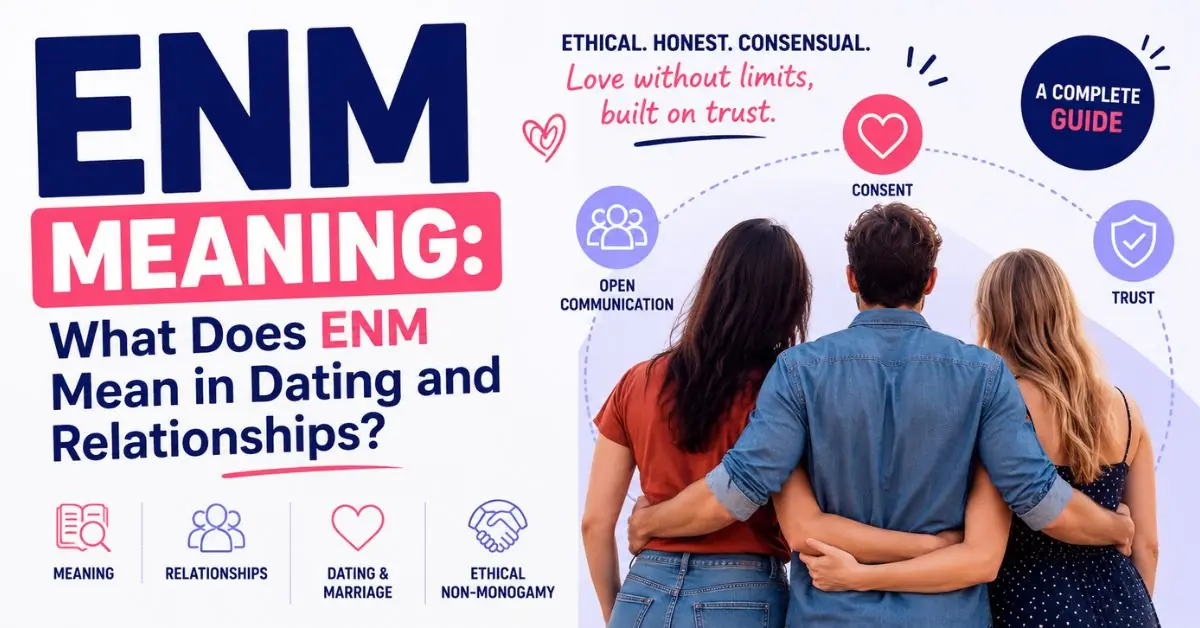
ENM Meaning is Ethical Non-Monogamy — an umbrella term for any relationship where all partners mutually consent to having multiple romantic, emotional, or sexual connections at the same time. The word ethical is the entire point: it separates consensual, transparent multi-partner relationships from cheating. ENM includes open relationships, polyamory, swinging, relationship anarchy, and several other structures.
Key Facts at a Glance
ENM full form: Ethical Non-Monogamy
Also called: CNM (Consensual Non-Monogamy) — used interchangeably
Core principle: All partners fully know and genuinely agree to the arrangement
Types include: Open relationships, polyamory, swinging, relationship anarchy, mono-poly, and more
Not the same as polyamory: Polyamory is one type of ENM, not the whole category
Not the same as swinging: Swinging is one type of ENM focused on recreational sex; ENM is broader
Key emotion: Compersion — the joy you feel when your partner is happy with someone else
Prevalence: Research suggests approximately 4–5% of relationships in the US are consensually non-monogamous
What Does ENM Mean?
ENM stands for Ethical Non-Monogamy. When you break those three words apart, you understand the concept pretty well: it’s non-monogamy (more than one partner) done ethically (with everyone’s full knowledge and genuine consent).
It’s an umbrella term — which means it doesn’t describe one specific type of relationship. Instead, it covers a whole range of structures, from a couple who occasionally explores connections with others, to someone who has three fully committed romantic partnerships running simultaneously. What all of them share is that nobody is being deceived.
You’ll see ENM on dating apps, in relationship therapy contexts, in Reddit communities, and increasingly in mainstream conversations about how people structure their love lives. The abbreviation itself is relatively new — it became widespread in the 2010s as non-monogamous relationships became more openly discussed — but the practices it describes are as old as human relationships.
Why “Ethical” Is the Whole Point
The word ethical in ENM isn’t decorative. It’s doing real work.
Non-monogamy on its own simply means having more than one romantic or sexual partner. Cheating is non-monogamy. So is an arranged polygamous marriage where one person has no say. Neither of those is what ENM describes.
The word “ethical” draws a clear line: everyone involved knows what’s happening, everyone has genuinely agreed to it, and everyone has the freedom to set their own limits within it. Remove any one of those three things and you’ve left the territory of ENM and entered something else entirely.
This is also why some people prefer the term CNM — Consensual Non-Monogamy — which puts the emphasis on consent rather than ethics. The two terms are used interchangeably, and they mean the same thing in practice.
ENM is just one of many internet abbreviations. You can also learn about PMO meaning, SMH meaning, and SYBAU meaning, which are frequently used in online conversations and text messages.
ENM vs. Cheating — The Real Difference
This is the most common misunderstanding about ENM, and it’s worth addressing directly.
| Factor | ENM | Cheating |
|---|---|---|
| Transparency | All partners know and are informed | Hidden from at least one partner |
| Consent | All partners have genuinely agreed | No consent — one partner is deceived |
| Trust | Built on communication and honesty | Fundamentally a breach of trust |
| Freedom to leave | Any partner can renegotiate or exit | One partner doesn’t know they have a reason to |
| Harm | Designed to minimize harm through openness | Causes harm through deception |
The distinction matters because ENM is sometimes dismissed as “just an excuse to cheat.” But the entire structure of ENM — the upfront conversations, the agreements, the ongoing check-ins — is the opposite of what cheating looks like. Cheating specifically requires deception. ENM specifically requires the absence of it.
Research note: Studies have found no significant difference in relationship satisfaction between ENM and monogamous couples. People in ENM relationships actually report higher levels of communication and openness with their partners than monogamous individuals, on average.
Three Core Pillars of Every ENM Relationship
Whatever structure an ENM relationship takes, these three things are non-negotiable. They’re what makes the “ethical” in the name real rather than theoretical.
🤝
Informed Consent
Every partner knows the full picture — not just what they need to know, but everything relevant to their wellbeing and decision-making.
💬
Communication
Ongoing, honest conversations about feelings, changes, boundaries, and agreements — before issues become crises.
🔍
Honesty
No selective truth-telling, no concealment of relevant information. The structure only works if everyone is working from the same facts.
These three pillars interact with each other constantly. Consent needs honesty to be real. Communication needs honesty to be useful. Honesty without communication goes nowhere. In practice, the most important skill in any ENM relationship isn’t logistics — it’s the ability and willingness to have uncomfortable conversations quickly rather than letting things fester.
Types of ENM Relationships
ENM is an umbrella, and underneath it sit a range of quite different relationship structures. Here’s what each one actually involves:
Most Common Type
Open Relationships
A primary couple — usually an established romantic partnership — agrees that one or both partners may have sexual connections (and sometimes emotional connections) with other people outside the couple. The couple remains the primary structure, and the “open” part refers to the possibility of connections beyond it. Open relationships vary enormously: some allow only sexual experiences outside the couple; others allow dating; others are asymmetric (one partner opens, one doesn’t).
Most Discussed Type
Polyamory
Polyamory is the practice of maintaining multiple romantic and emotional relationships simultaneously, with the knowledge and consent of everyone involved. Unlike open relationships, polyamory isn’t necessarily organized around a central couple — the structure can be more fluid, with several people equally connected to each other. Polyamory places emphasis on love and emotional depth, not just sexual freedom.
Kitchen Table Polyamory
All partners know each other, spend time together, and feel comfortable around each other — the metaphor being that everyone could sit around the kitchen table and have breakfast together. It tends to create a more family-like, interconnected community of partners.
Parallel Polyamory
Partners maintain separate relationships that don’t need to overlap. Your partners may know of each other’s existence, but they don’t interact or build relationships with each other. Each relationship stays in its own lane.
Solo Polyamory
Someone who prioritizes their independence and doesn’t want a “primary” style partnership — no shared finances, no cohabitation, no expectation of escalation toward those milestones. They may have multiple loving relationships but maintain their own autonomous life as the center of gravity.
Sexually Focused
Swinging
Swinging typically involves couples who engage in sexual experiences with other couples or individuals, often in social settings like lifestyle events or parties. The emphasis is on the recreational, sexual aspect rather than building ongoing emotional connections. Swingers often maintain a strong primary partnership and view the external sexual experiences as something they do together as a couple, rather than separately.
Least Structured
Relationship Anarchy
Relationship anarchy rejects the idea that relationships should be categorized — that romantic partnerships are automatically more important than friendships, or that there should be a hierarchy of “primary” and “secondary” connections at all. Practitioners define each relationship on its own terms, without applying pre-set rules or labels. This is probably the most autonomous form of ENM and tends to appeal to people who find all relationship categories artificially limiting.
Mixed Structure
Mono-Poly
A mono-poly relationship is one where one partner practices ENM and the other remains monogamous. They are deeply in love with each other, but one chooses to have only that relationship while the other maintains additional connections. These require particularly clear communication and mutual genuine agreement — they don’t work when one person is simply tolerating the arrangement to keep the relationship intact.
Occasionally Open
Monogamish
Coined by writer Dan Savage, “monogamish” describes a primarily monogamous relationship that occasionally, and mutually, opens up — usually for specific sexual experiences rather than ongoing outside partnerships. Think of it as mostly closed with specific agreed exceptions, rather than a standing open structure.
ENM Vocabulary You Need to Know
If you’re exploring ENM, you’ll run into terms that don’t appear in everyday relationship conversations. Here’s what they actually mean:
Compersion
The feeling of joy or happiness you experience when your partner feels happy with or because of someone else. Often called the opposite of jealousy — you’re not threatened by your partner’s other connection; you’re genuinely happy for them. One of the most discussed and sought-after emotional states in ENM.
Metamour
Your partner’s other partner — someone you are connected to through a shared partner but aren’t romantically involved with yourself. In kitchen-table polyamory, metamours may be close friends. In parallel polyamory, they may barely interact.
NRE (New Relationship Energy)
The intense, euphoric feeling that comes with a new romantic or sexual connection — the “honeymoon phase.” In ENM, NRE can be destabilizing because a person deep in NRE with someone new may unconsciously deprioritize existing partners. Recognizing NRE and managing it intentionally is considered an important skill in ENM.
DADT (Don’t Ask, Don’t Tell)
An agreement between ENM partners where one or both chooses not to hear details about the other’s outside connections. While it gives privacy, DADT is controversial in ENM communities because it can create a situation that feels more like mutual ignorance than genuine ethical consent — and can make it harder to flag genuine problems early.
Nesting Partner
A partner you live with. In polyamory, this is someone who shares your everyday domestic life, regardless of whether they’re a “primary” partner in the traditional sense.
Throuple / Triad
Three people who are all romantically and/or sexually involved with each other — a three-person relationship rather than one person connected to two separate partners.
Quad
Four people who are all romantically and/or sexually connected with each other. Often forms when two couples become romantically involved with each other as a group.
Vee (Closed V)
One person — the “hinge” — is romantically connected to two others who are not romantically connected to each other. Picture the shape of the letter V: the hinge is at the bottom point, the two partners are at the top.
What Is the 100-Mile Rule in ENM?
The 100-mile rule is a specific agreement that some ENM couples make, most commonly in open relationship and swinging contexts. The agreement: partners will only engage with other people when they’re at least 100 miles away from home.
The practical reason is straightforward. If you live in a city and you engage with people in that same city, there’s a real chance you’ll run into them — at a grocery store, at a friend’s party, at work. That kind of overlap can create social awkwardness or complications that neither partner wants to manage. The 100-mile buffer reduces that risk significantly.
It’s important to note that the 100-mile rule is a personal agreement between specific partners — not a formal ENM rule or community-wide norm. Some couples find it useful; many ENM practitioners don’t apply it at all. Like all ENM agreements, it works because the people involved choose it together, not because it’s expected of them.
Is ENM the Same as Polyamory?
No — and this is probably the most common source of confusion. ENM is the broader category. Polyamory is one specific type within it.
Simple version: All polyamory is ENM. Not all ENM is polyamory.
Polyamory specifically involves multiple romantic and emotional connections — love being the operative ingredient. Other forms of ENM might involve multiple sexual connections without the emotional depth that polyamory implies, or structures like swinging where the couple is the unit and outside connections are recreational rather than romantic.
Someone who practices swinging with their spouse isn’t necessarily polyamorous — they haven’t taken on additional romantic partners. But they are practicing ENM, because those outside sexual experiences happen with everyone’s knowledge and consent.
Is ENM the Same as Swinging?
No. Swinging is one type of ENM, but ENM is much broader than swinging.
| Factor | Swinging | ENM (broader) |
|---|---|---|
| Focus | Recreational sexual experiences | Any consensual multi-partner structure |
| Emotional connections outside the couple | Usually minimal or avoided | Can include deep emotional and romantic connections |
| Typical structure | Couple-centric — outside activity done together or with shared awareness | Many structures, not necessarily couple-centric |
| Where it happens | Often at organized social events (“lifestyle” parties) | In everyday life, through dating, friendships that evolve, etc. |
Swingers often identify strongly with a distinct “lifestyle” community that has its own events, norms, and vocabulary — and many swingers don’t identify as polyamorous or ENM at all, even though their relationship structure would technically qualify. Language in this space is imperfect and evolving.
ENM vs. CNM — What’s the Difference?
In practice, nothing. ENM (Ethical Non-Monogamy) and CNM (Consensual Non-Monogamy) are two names for the same broad concept, and most people in these communities use them interchangeably.
The slight philosophical distinction: CNM emphasizes the consensual nature of all agreements — every action is explicitly agreed upon. ENM emphasizes the ethical framework around how people treat each other. Some researchers and therapists prefer CNM because it’s more precise about consent; some community members prefer ENM because it centers the ethical dimension of behavior, not just the technical presence of consent.
If someone says ENM and you hear CNM, or vice versa — they almost certainly mean the same thing.
What Is an ENM Party?
An ENM party — sometimes called a lifestyle event, a play party, or a mixer — is a social gathering specifically for people who practice ethical non-monogamy. These events vary enormously in format.
- Social mixers: Dinner parties, meetups, or events where ENM individuals and couples meet and socialize in a non-sexual environment — similar to any community gathering but specifically for this community.
- Lifestyle parties (swinging-oriented): Events that include spaces where sexual activity may occur, organized specifically for people in the swinging or open relationship community.
- Polyamory community events: Discussion groups, workshops, and social events for people practicing polyamory — often educational or community-building rather than explicitly sexual.
ENM events are organized through local community groups, dedicated apps and websites, and national lifestyle organizations. They operate privately, usually require some form of vetting or community membership, and have their own codes of conduct around consent and behavior.
Is ENM Right for You?
This is the question most people are really asking when they search for “ENM meaning.” Here are the honest factors worth considering:
Questions to ask yourself
- How do you genuinely feel about your partner having other connections? Not how you think you should feel — how you actually feel when you sit with that thought.
- Are you comfortable with ongoing, uncomfortable conversations? ENM requires regular renegotiation of boundaries and honest discussion of feelings that might be hard to articulate. It doesn’t work well for people who avoid conflict.
- Is this genuinely mutual? ENM that one partner reluctantly agrees to in order to preserve the relationship tends to collapse under pressure. Genuine mutual interest — not one person tolerating it — is the baseline.
- Do you have the time and emotional bandwidth? Multiple relationships require real investment. People who feel stretched thin by one relationship often find ENM compounds rather than resolves that.
- What are you hoping ENM will solve? ENM works well as a relationship choice. It tends to fail when it’s used as a solution to an existing problem in one relationship — like low intimacy, disconnection, or avoiding a difficult conversation about what you both actually want.
What research suggests
Research on ENM relationships consistently finds no significant difference in relationship satisfaction between ENM and monogamous couples. ENM practitioners report higher levels of communication and openness with partners. Jealousy exists in ENM relationships — it doesn’t disappear — but people in ENM relationships often develop specific ways of processing and communicating about it rather than acting on it impulsively.
Important note: If you’re exploring ENM because of a specific problem in your current relationship, talking to a couples therapist first is worth doing — ideally one who is knowledgeable about and non-judgmental toward non-monogamous relationships. ENM is a relationship structure, not a fix.
ENM Medical Meaning
If you’re searching “ENM meaning medical,” the short answer is: in everyday language and online contexts, ENM almost always means Ethical Non-Monogamy.
In medical literature, ENM occasionally appears as shorthand for different things depending on the specialty, but it has no single universal medical definition. If you’ve encountered “ENM” in a medical document or clinical context, check the specific abbreviation list for that document or publication — it likely means something specific to that specialty that isn’t the relationship term.
The relationship meaning is by far the dominant usage of the acronym ENM in contemporary English.
Frequently Asked Questions
What does ENM mean?
ENM stands for Ethical Non-Monogamy — an umbrella term for any relationship structure where all partners fully consent to multiple romantic, emotional, or sexual connections simultaneously. The “ethical” part means everything is transparent and consensual, which is what separates it from cheating.
What does ENM mean in dating?
In dating, ENM means a person is open to or currently practicing Ethical Non-Monogamy. When someone lists ENM on a dating profile, they’re signaling that they may be dating multiple people simultaneously, with everyone’s knowledge, or that they’re open to building that kind of relationship.
What is the 100-mile rule in dating?
The 100-mile rule is a specific agreement some ENM couples make, especially in open or swinging contexts: they will only engage with other partners when at least 100 miles from home. This reduces the chance of running into those partners socially and keeps outside connections separate from everyday life.
Is ENM the same as polyamory?
No. ENM is the umbrella category; polyamory is one type within it. All polyamory is ENM, but ENM also includes open relationships, swinging, relationship anarchy, and other structures. Polyamory specifically involves multiple romantic and emotional connections; other ENM structures may focus more on sexual freedom without additional romantic relationships.
Is ENM the same as swinging?
No. Swinging is one type of ENM, focused primarily on recreational sexual activity between consenting couples or individuals. ENM is the broader category that includes swinging, polyamory, open relationships, and more. Swinging typically doesn’t involve building ongoing romantic or emotional connections outside the primary couple.
What is compersion in ENM relationships?
Compersion is the feeling of joy or happiness you experience when your partner is happy with or because of someone else. It’s often called the opposite of jealousy — instead of feeling threatened, you feel genuinely pleased for your partner. It’s one of the most discussed emotional states in ENM communities and something many people develop over time with experience and communication.
What does ENM mean in a medical context?
In standard everyday language and online contexts, ENM means Ethical Non-Monogamy. In medical literature, ENM doesn’t have a universally recognized single definition — it may appear as shorthand for different terms in different specialties. If you’ve seen it in a clinical document, check the abbreviation key for that specific text.
What is the difference between ENM and CNM?
ENM (Ethical Non-Monogamy) and CNM (Consensual Non-Monogamy) are used interchangeably by most people. Both describe relationships with multiple partners and full mutual knowledge and consent. In practice, they mean the same thing.
Conclusion
ENM — Ethical Non-Monogamy — is a genuinely simple concept that often gets tangled in either stigma or oversimplification. At its core, it’s just a way of saying: here is a relationship structure where nobody is being deceived. That’s it. The “ethical” isn’t a stamp of moral superiority over monogamy; it’s a marker that separates consensual arrangements from situations where someone is being lied to.
What makes ENM complex isn’t the concept. It’s the practice — the communication load, the management of jealousy and NRE, the constant renegotiation of what agreements mean as circumstances change, and the social stigma that still attaches to anyone who mentions it. Those are real challenges, and people who practice ENM successfully tend to describe it as something they work at deliberately, not something that runs on autopilot because everyone has “agreed.”
Whether ENM is something you’re curious about, something your partner has raised, or something you’ve seen on a dating app and wanted to understand — the most useful thing you can take from this is that it isn’t one thing. Open relationships, polyamory, swinging, relationship anarchy — each one has its own logic, its own requirements, and its own distinct experience. The label ENM just tells you they share a foundation of consent and transparency. What gets built on that foundation is a conversation between the specific people involved.
One Comment