FAFO Meaning: What Does FAFO Mean and Stand For?
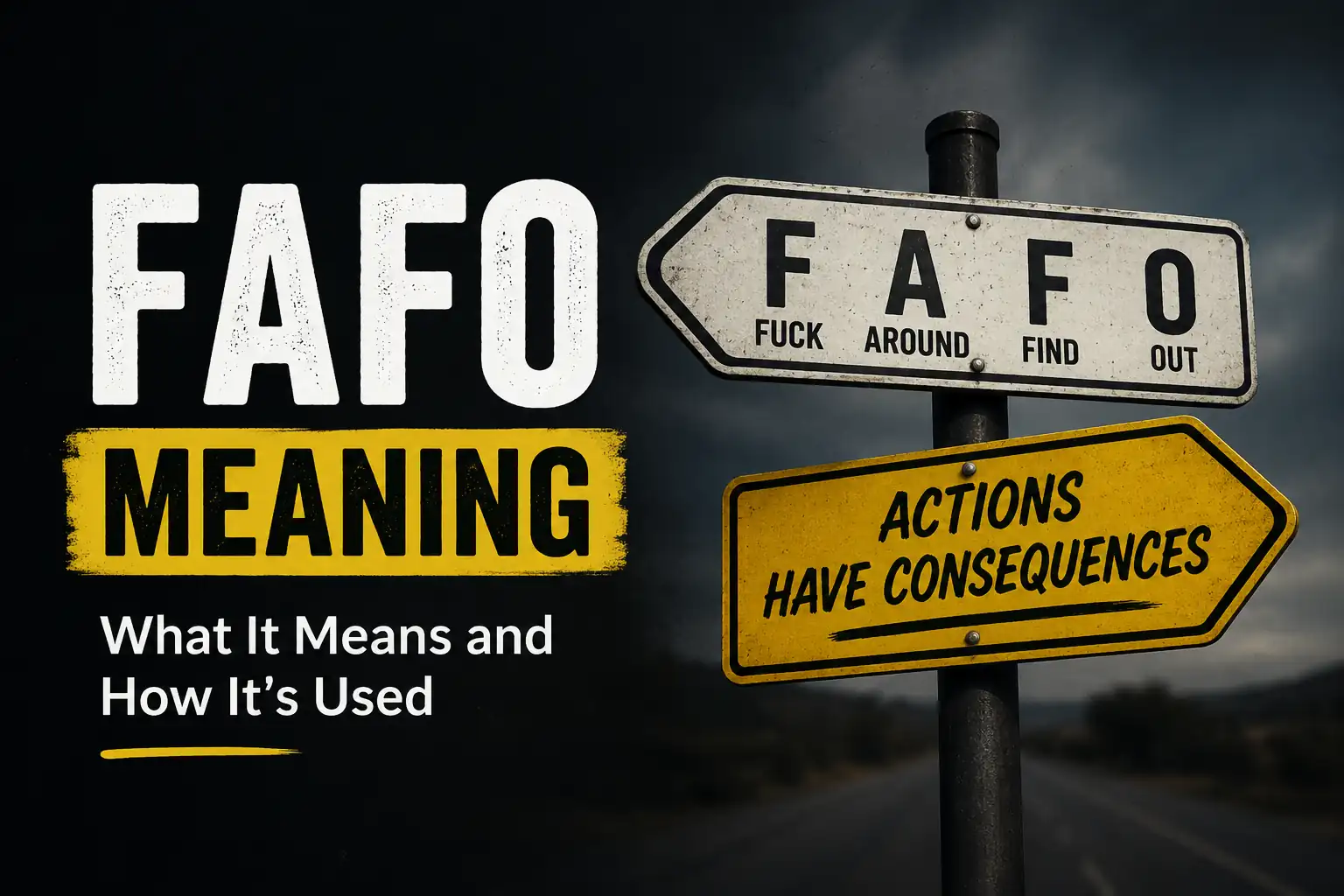
FAFO meaning refers to the phrase “f*** around and find out” (often softened to “fool around and find out”). It’s a popular internet slang term used to warn someone that reckless, aggressive, or foolish behavior will lead to swift, usually unpleasant, consequences — and it’s just as often used after the fact, as a satisfied reaction once those consequences actually land.
Key Takeaways
Full form: “F*** around and find out” — a warning that actions have consequences.
Roots: The underlying phrase traces to African American English and has circulated in print since at least the 2000s.
Breakout moment: Went mainstream in late 2022 after Elon Musk tweeted “FAFO” in a viral exchange involving Kanye West.
Beyond memes: Used as a motto in military and veteran circles, a political slogan, and a real bill name — the FAFO Act in the U.S. Congress.
Parenting trend: “FAFO parenting” describes letting kids learn from natural consequences instead of constant intervention.
Pronunciation is unsettled: Some say it as a word (“FAFF-oh”); others spell it out letter by letter.
What Does FAFO Mean?
FAFO is one of the rare internet acronyms that jumped from meme culture into news headlines, congressional bill names, and a U.S. cabinet official’s public remarks — all within a few years. At its core, it’s simple: FAFO stands for “f*** around and find out,” a blunt way of saying that messing with someone or something reckless will eventually catch up with you.
What makes FAFO interesting is how flexible it is. It works as a threat (“Keep pushing and you’ll FAFO”), as a description of someone already facing consequences (“Classic FAFO moment”), and as commentary on everything from a viral video to a foreign policy decision. It’s less a single insult and more a compact philosophy: actions have consequences, and sometimes people have to learn that the hard way. Like other trending internet slang terms, including the sybau meaning, FAFO has become part of online culture, helping users express complex ideas with just a few letters.
FAFO Meaning: Full Form & Pronunciation
| Letter | Stands For |
|---|---|
| F | F*** |
| A | Around |
| F | Find |
| O | Out |
Because the phrase is used so much more often in writing than in speech, there’s genuinely no settled answer on how to say it out loud. Some people pronounce it as a single invented word, roughly “FAFF-oh,” treating it like an acronym such as NASA or SCUBA. Others spell it out letter by letter — F, A, F, O — treating it as an initialism, the way people say “FBI” rather than a made-up word. Both are common, and neither is “wrong.”
Polite version: In family-friendly writing, news coverage, and workplace-safe conversation, FAFO is frequently softened to “fool around and find out,” which keeps the warning intact without the profanity.
Origin & History of the FAFO Meaning
Tracing FAFO’s exact starting point is harder than it looks, because the acronym and the underlying phrase have two separate histories.
The phrase “f*** around and find out” has its roots in African American English and has been documented in print since at least the early 2000s, well before it became a four-letter internet shorthand. It carries the same logic as much older folk warnings — the idea that provoking trouble eventually invites trouble — but with a sharper, more confrontational edge.
A separate, frequently repeated origin theory connects FAFO to the Gadsden Flag — the yellow Revolutionary War-era flag featuring a coiled snake and the words “Don’t Tread on Me.” In that reading, stepping on the snake (treading on it despite the warning) is “f***ing around,” and getting bitten is “finding out.” While this connection shows up often in slang explainers, it functions more as a popular folk etymology that helps explain the phrase’s “don’t test me” attitude than as a documented, verified source.
From there, FAFO moved through early-2010s meme culture, gaming trash talk, and online political arguments before becoming one of the internet’s default ways to caption a consequence.
How FAFO Became 2022’s Defining Slang Term
FAFO had circulated online for years, but it broke into mainstream awareness through one specific viral moment. Near the end of 2022, Elon Musk tweeted the acronym in response to Kanye West being suspended from Twitter (now X) after posting an image many considered antisemitic, including content involving Musk himself. The exchange was widely covered, and language commentators — including The Washington Post — pointed to that moment as a turning point that helped cement FAFO as one of the year’s standout slang terms.
2000s — Underlying phrase documented in print, rooted in African American English.
2010s — Spreads through memes, gaming culture, and Urban Dictionary-style slang lists.
Late 2022 — Goes viral after Elon Musk’s tweet referencing the Kanye West Twitter suspension; named among 2022’s defining slang terms.
2023–2024 — Adopted as a political slogan (including by groups such as the Proud Boys) and as TikTok caption shorthand for consequence-driven viral clips.
2025 — Used by U.S. Secretary of War Pete Hegseth in remarks to military commanders; reused as the name of the proposed FAFO Act in Congress; “FAFO parenting” gains traction as a parenting-style label.
How FAFO Functions Grammatically
Part of why FAFO has stuck around is that it bends into almost any part of speech:
- As an interjection: “FAFO.” (standalone reaction)
- As a verb: “He FAFO’d hard with that comment.”
- As a noun: “That was a textbook FAFO.”
- As an adjective: “It was a total FAFO moment.”
- As a hashtag: #FAFO, used to tag videos and posts about consequences.
This flexibility is unusual even among internet acronyms, and it’s a big part of why FAFO shows up so naturally in headlines, captions, and casual speech alike.
FAFO in Military Culture
FAFO resonates strongly with military and veteran communities, where it’s embraced as a blunt expression of accountability and “don’t test us” confidence. It appears regularly on patches, mugs, stickers, and apparel marketed to service members and veterans, and it’s a frequent topic on military-focused forums and subreddits, often used half-jokingly as a kind of unofficial motto.
The phrase reached a notably public moment in September 2025, when U.S. Secretary of War Pete Hegseth used it while addressing top military commanders, reportedly stating that adversaries who challenge the United States would face severe consequences and spelling out “F-A-F-O” for emphasis. That moment pushed FAFO further into mainstream news coverage as shorthand tied to military deterrence messaging.
Context matters: Even within military and veteran circles, FAFO is generally understood as informal, morale-boosting language rather than an official directive or doctrine term — it doesn’t appear in formal military terminology glossaries.
FAFO in Politics — Including the FAFO Act
FAFO has crossed into political usage from multiple directions, and not from just one side of the spectrum:
- As protest and rally language: The phrase has been used as a slogan and printed on merchandise by various political and activist groups, including the Proud Boys, well before the 2024 election cycle.
- As political commentary: Commentators, prosecutors, and pundits across the political spectrum have used “FAFO moment” as shorthand when describing a politician, policy, or public figure facing the consequences of a risky decision.
- As actual legislation: In June 2025, U.S. Representative Pat Harrigan (R-NC) introduced the Foreign Adversary Federal Offense Act — deliberately abbreviated as the FAFO Act (H.R. 4081). The bill proposes mandatory minimum prison sentences (10 years for economic espionage, 15 years for defense-related espionage on behalf of countries including China, Russia, Iran, and North Korea), along with steep corporate fines, for individuals and companies caught committing espionage on behalf of foreign adversaries.
The FAFO Act is a good example of how thoroughly the slang term has entered mainstream vocabulary: lawmakers chose the acronym specifically because of its recognizable “there will be consequences” connotation, not because it was a coincidence.
FAFO Parenting: Meaning and Examples
“FAFO parenting” is a parenting style that’s gained real traction in parenting blogs and social media discussions, distinct from the internet-warning use of the term. It describes a hands-off approach where caregivers let kids experience the natural consequences of their own choices, rather than constantly explaining, negotiating, or stepping in to prevent discomfort.
Common examples of FAFO parenting
- A child refuses to wear a coat on a cold day — and learns firsthand why the coat was suggested.
- A teen skips homework despite reminders — and deals with the resulting grade.
- A child forgets their packed lunch after being reminded — and experiences being hungry until the next meal.
Why it’s trending
FAFO parenting has grown partly as a reaction to gentle parenting, which emphasizes ongoing emotional validation and explanation. Some parents feel burned out by constant negotiation and find FAFO parenting freeing, since it shifts responsibility onto the child’s choices. Critics, however, argue that used without warmth or safety limits, it can feel cold, unsupportive, or even neglectful — particularly for anxious or younger children.
| Aspect | FAFO Parenting | Gentle Parenting |
|---|---|---|
| Core idea | Let natural consequences teach the lesson | Validate feelings, explain reasoning, co-regulate |
| Parent’s role | Set the boundary, then step back | Stay closely involved through the emotional process |
| Best suited for | Safe, low-stakes, age-appropriate situations | Emotional regulation and connection-building moments |
| Main risk | Can feel harsh without warmth or safety checks | Can lead to over-explaining and parental burnout |
Most child-development-informed takes on FAFO parenting suggest using it selectively — in safe, age-appropriate situations — rather than as a complete parenting philosophy, and pairing it with empathy after the consequence lands rather than an “I told you so.”
FAFO on TikTok & Social Media
On TikTok specifically, FAFO functions as instant commentary on viral clips. A widely shared chart format, popularized by creators showing a simple “action → consequence” structure, became a common reaction template for FAFO-tagged posts. The hashtag is used across an enormous range of content — from someone testing an aggressive dog despite a “Beware” sign, to a person trying to scam a stranger and getting caught, to political and current-events clips.
FAFO has also attached itself to specific public figures in meme culture. One notable example is content creator Saleh Aljafarawi, who was nicknamed “Mr. FAFO” online amid disputes over the authenticity of his social media content — illustrating how the term gets applied not just to actions, but to entire online personas associated with getting “caught.”
Is FAFO Considered Vulgar or Offensive?
Short answer: technically yes, practically it depends on context.
- Reference sources like Merriam-Webster classify FAFO as slang derived directly from a profane phrase, so by definition, it contains vulgarity.
- In practice, because it’s almost always written as an acronym rather than spelled out, it reads as far less jarring than the full phrase would.
- The “fool around and find out” variant is widely used as a clean substitute in news articles, workplace-safe conversations, and content aimed at younger audiences.
- It is not a slur and isn’t tied to one political group, demographic, or ideology — it’s been used across the political spectrum, by veterans, parents, comedians, and lawmakers alike.
Where to be careful: Despite its mainstream spread, FAFO still contains implied or literal profanity. Avoid the unabbreviated phrase in professional writing, and use judgment with the acronym itself in formal or unfamiliar settings.
How to Use FAFO (With Examples)
As a warning
“Keep ignoring the warning signs and you’re going to FAFO.”
“Push your luck with that landlord and FAFO.”
As a reaction to consequences already happening
“He skipped every safety briefing and then got hurt. Classic FAFO.”
“She ignored every red flag in that deal. FAFO.”
As commentary on news or politics
“Analysts called the policy reversal a major FAFO moment for the administration.”
When to avoid it: Formal writing, customer-facing professional communication, and any context where profanity-adjacent slang would undermine your credibility.
Similar Phrases & Related Slang
| Term | Meaning | Notes |
|---|---|---|
| FAFO | F*** around and find out | Internet slang, now also political and military shorthand |
| “Play stupid games, win stupid prizes” | Reckless choices bring bad outcomes | Older, non-acronym idiom with the same core message |
| SNAFU | Situation normal, all f***ed up | WWII-era military acronym; describes chaos, not consequences |
| GTFO | Get the f*** out | A command to leave, unrelated to the “consequences” theme |
| LIFO / FIFO | Last in, first out / First in, first out | Unrelated accounting and inventory terms; sometimes confused with FAFO purely because of the rhyme |
That last entry is worth a quick note: in accounting and inventory management, LIFO and FIFO are standard, formally defined methods with no connection to the slang term FAFO. Any overlap is coincidental wordplay, not a shared meaning — though it’s common enough online to spark a joke or two among accountants.
Frequently Asked Questions
What does FAFO mean?
FAFO stands for “f*** around and find out” (often softened to “fool around and find out”). It’s used as a warning that reckless, aggressive, or foolish behavior will lead to swift, usually negative, consequences — and also as a satisfied reaction once those consequences actually happen.
Is FAFO considered vulgar?
Merriam-Webster classifies FAFO as slang built from a profane phrase, so it is considered vulgar in its uncensored form. In practice, most people read it as edgy rather than shocking, since the abbreviation softens the impact, and the “fool around” variant is commonly used as a polite substitute in workplaces, news coverage, and family-friendly contexts.
What does FAFO mean in slang on TikTok?
On TikTok, FAFO is used as a caption or comment on videos where someone faces the consequences of a reckless, rude, or foolish decision — a person ignoring a warning sign, a scammer getting caught, or a bully getting confronted. It functions as instant commentary: “this is what happens when you push your luck.”
Is FAFO a new or old saying?
The underlying phrase, “f*** around and find out,” has roots in African American English and has been used in print since at least the 2000s, making the saying itself fairly old by internet-slang standards. The acronym FAFO became mainstream much more recently, surging in late 2022 after a viral Elon Musk tweet and going on to be named a notable slang term of that year.
What is the FAFO trend?
The FAFO trend refers to the surge of FAFO-tagged content across TikTok, X, and Instagram showing real or staged moments where someone’s risky, rude, or foolish behavior immediately backfires. It also covers parallel trends like “FAFO parenting” and FAFO’s adoption as merchandise and a slogan in military and political circles.
What does FAFO mean in the military?
In military and veteran culture, FAFO is used as a blunt warning or motto reflecting a no-nonsense, consequences-first mindset — popular enough to appear on patches, mugs, and gear. It gained wider attention in September 2025 when U.S. Secretary of War Pete Hegseth used the phrase while addressing military leadership.
What does FAFO mean in law or legal contexts?
FAFO has no formal legal definition, but the acronym was reused in 2025 as the nickname for the proposed Foreign Adversary Federal Offense (FAFO) Act, U.S. legislation setting mandatory minimum sentences for espionage on behalf of foreign adversaries. Outside that specific bill, “FAFO” in a legal context is just the slang phrase, not a recognized legal term.
What is FAFO parenting?
FAFO parenting is a parenting style where caregivers let children experience the natural consequences of their own choices — like getting cold without a jacket, or a lower grade for skipped homework — rather than constantly explaining, negotiating, or rescuing them. It’s often framed as a firmer counterpoint to gentle parenting, though experts generally recommend pairing it with warmth and safety-conscious limits.
Is FAFO related to Trump, MAGA, or any specific political side?
No single political side owns FAFO. It has been used as merchandise and rally language by some right-leaning groups, referenced by Democratic-aligned commentators describing political opponents’ missteps, and used in official Republican-sponsored legislation (the FAFO Act). It’s best understood as a broadly adopted slang term rather than language tied to one party or movement.
2 Comments